Aug 14, 2026, 5:40 AM ETHardware
Gaussian splatting is getting its own silicon
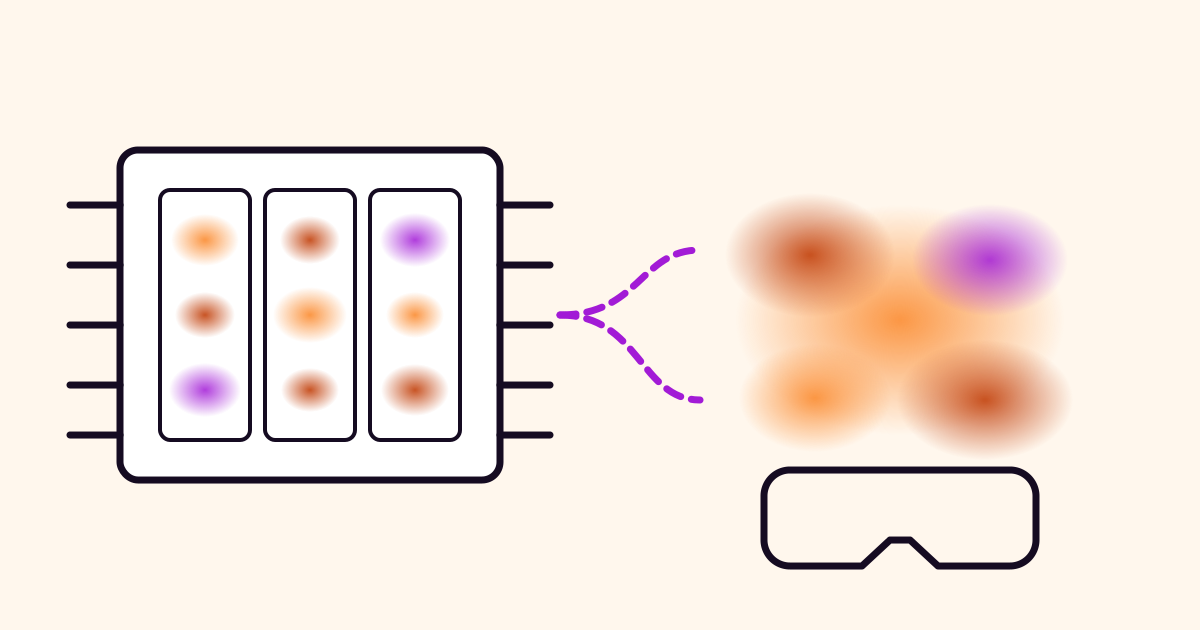
Illustration: Splats Newsroom · Hardware
A team led by Siddarth Gottumukkula and Priyesh Shukla has proposed ProbSplat, a compute-in-memory chip architecture that stores gaussians as physical charge and evaluates their log-likelihoods in analog — targeting the power budget of standalone AR/VR headsets and edge robots rather than a desktop GPU.
Why it matters: Every splat pipeline shipping today assumes a GPU somewhere — on the device, or in the cloud with a round trip. That assumption is what keeps live reconstruction off untethered headsets and small robots.
ProbSplat attacks the arithmetic itself rather than the software: instead of moving gaussian parameters between memory and a digital multiplier, it stores them as transistor threshold voltages and lets physics do the math.
Zoom in: The design uses programmable floating-gate inverter columns that hold both the mean and the variance of each gaussian mixture component — and, critically, lets the two be tuned independently, which earlier probabilistic-computing hardware struggled to do.
By the numbers:
- 18 picojoules per log-likelihood inference at 4-bit precision.
- 500 mixture functions handled in a single 3D gaussian mixture model.
- Under 2.4% deviation from true mean-variance independence.
- 21.99 dB PSNR reconstruction fidelity at 8-bit precision.
Yes, but: This is a simulation, not a fabricated chip — and it is simulated in 180nm CMOS at 50 MHz, a node several generations behind anything in a shipping headset. The energy figures are a promise about the architecture, not a measured product.
The 21.99 dB reconstruction fidelity is also well short of what GPU splatting delivers; the pitch is watts, not picture quality.
The big picture: Splatting spent three years becoming a software format. Purpose-built silicon is what a format looks like when it starts becoming infrastructure — the same arc GPUs took for triangles and NPUs took for neural nets.
Go deeper: