Aug 15, 2026, 8:20 AM ETHardware
One exposure in, a whole 3D scene out
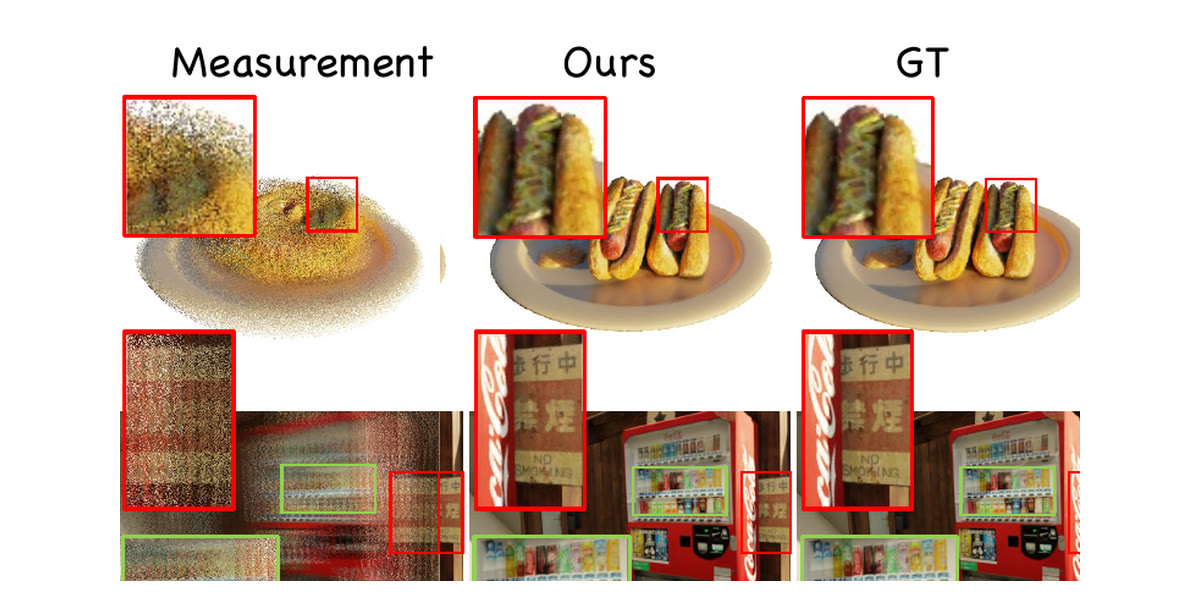
Figure: Yang et al., Westlake University AGI Lab · Hardware
Yanming Yang, Chenxi Song and colleagues at Westlake University's AGI Lab have built GS²CI, which reconstructs a 3D gaussian splatting scene from a single snapshot compressive imaging measurement by leaning on the priors inside large vision foundation models.
Why it matters: Snapshot compressive imaging is a camera trick with a real payoff: modulate the incoming light with a set of masks during one exposure, and many temporal frames land encoded in a single 2D readout. It is how you get high-speed capture without a high-speed sensor, and without the data rate that comes with one.
If a scene moves relative to the camera during that exposure, the single measurement also contains multiple viewpoints. Which means one frame, in principle, holds a 3D scene.
The problem: In practice that measurement is a bad citizen. Compression discards fine detail, viewpoint diversity is thin, pose estimation is badly ill-posed, and the optimiser has to solve for the 3D representation and the camera poses at the same time.
Earlier attempts leaned on NeRF and needed tens of thousands of iterations per scene. The supervision signal is ambiguous enough that gaussian splatting optimisation goes unstable — gaussians inflate their opacity to paper over the loss rather than actually fitting the scene.
Zoom in:
- Initialisation comes from a 3D vision foundation model run on the measurement, followed by SCI-aware gaussian optimisation.
- After the coarse stage converges, a 2D foundation model supplies pseudo-view supervision at synthesised viewpoints to sharpen local appearance.
- Opacity-Guided Splitting and Growth Regulation is the stability fix: it uses local opacity statistics to pick split candidates, penalises mean-opacity inflation, and caps how far the representation can grow.
- Code is published at github.com/Westlake-AGI-Lab/GS2CI.
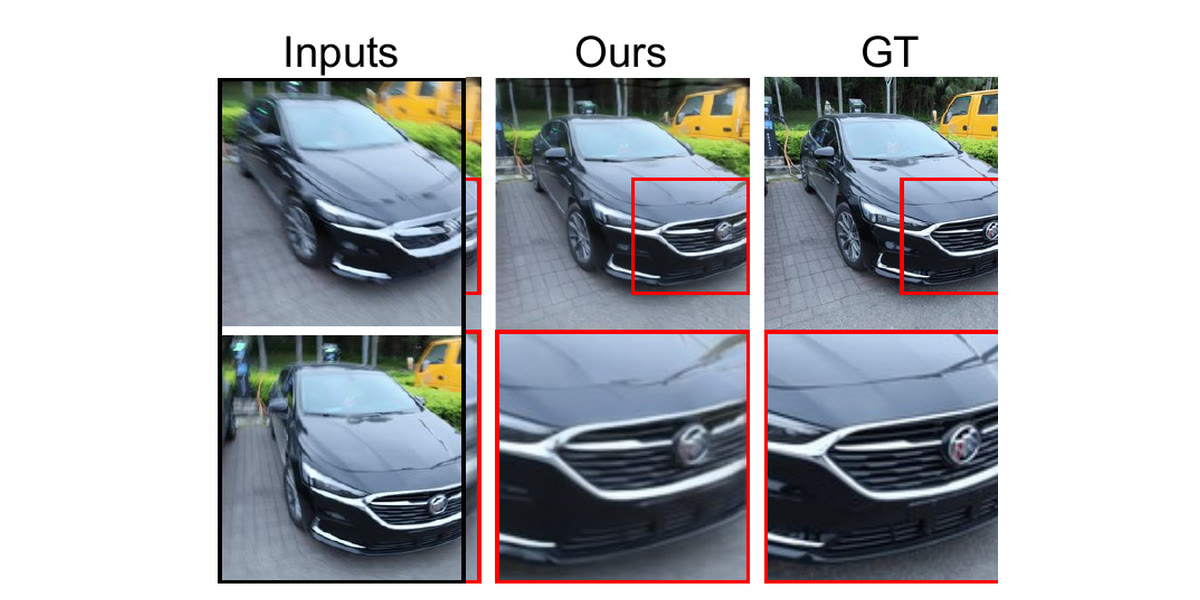
The tell: The comparison figure is the argument. The raw measurement is an unreadable scatter of noise; the reconstruction beside it is a plate of hot dogs and a vending machine, close enough to ground truth that you have to hunt for the difference.
The authors report best or second-best results on nearly every scene and metric across six scenes, with the clearest gains in perceptual quality rather than raw PSNR.
What's next: The dependence on foundation-model priors is the thing to watch. Performance is partly inherited from whatever those models already know about the world, which is a strength on ordinary scenes and an open question on anything unusual.
But the direction is clear enough: capture hardware gets cheaper and dumber, and the reconstruction absorbs the difficulty.