Volumetric video turns privacy into a 3D problem
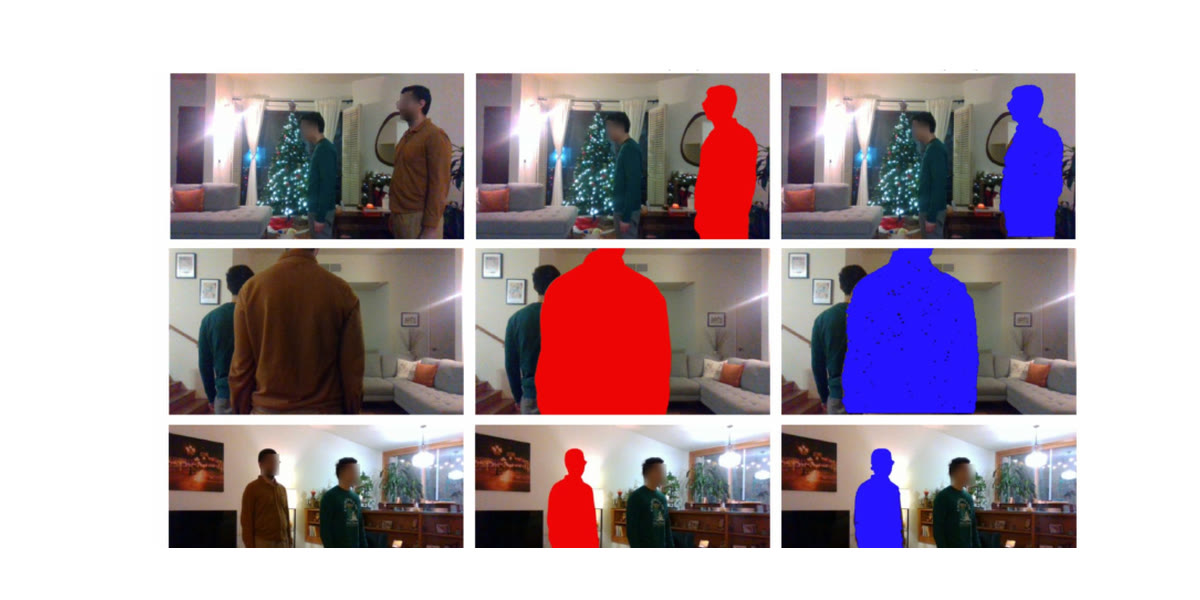
Figure: Khalili et al., UCLA / Nokia Bell Labs · Research

Aug 15, 2026, 5:30 AM ETResearch
Hossein Khalili and colleagues at UCLA and Nokia Bell Labs have built InViStream, a system that removes private content from RGB-D streams on the camera side, before anything is fused into a shared 3D scene.
Why it matters: Ordinary video can be redacted frame by frame. A volumetric pipeline can't be, because the thing you are trying to hide is reconstructed from several cameras at once — miss it in one view and it reappears in the fused scene.
Every pitch for volumetric telepresence assumes people will put these rigs in offices and living rooms. That is the argument this paper takes seriously: capture the room and you capture the mail on the counter, the whiteboard, and whoever walks through the shot.
The problem: Existing privacy-preserving vision work is built for one camera and one frame. It has no notion of the same object appearing differently across calibrated views, which is the whole difficulty here.
Masking the colour channel isn't enough either. Strip a person out of RGB and their geometry is still sitting in the depth map — the authors call this geometric privacy leakage, and it survives into the point cloud.
Zoom in:
- Object detection is paired with depth-aware masking, so the removal happens in geometry as well as colour.
- Public/private decisions are propagated across calibrated views, so a decision made in one camera holds in the others.
- Only sanitised point clouds are fused — the filtering happens before data leaves the camera, not at the server.
- Reported Dice/Recall of 0.799/0.891 on synthetic scenes and 0.792/0.908 on real ones, SSIM above 0.98, streaming above 30 FPS.
- Tested against a person detector run on the output, the rate at which a private person is still detectable falls to about 6.3% on synthetic scenes and 14.3% on real ones.
Yes, but: Crowds are where it strains. With two public and two private people in a scene, Dice falls to 0.656 — everyone shares the same detector label, so the system leans on calibration and matching to tell them apart.
The authors are candid that the system errs toward overmasking: it will remove extra pixels near a private person rather than risk exposing them. Recall stays high, precision pays for it. For a privacy tool that is the right way round, but it means public parts of the scene get eaten too.
What's next: The interesting claim is architectural, not numerical: privacy belongs at the source, on the critical path, running at frame rate. Every system that ships raw RGB-D to a server and filters later has already lost the argument.
Whether a 30 FPS budget survives contact with consumer capture hardware is the open question.