SplatsThe evolution of media, in brief
RSS

CausalSplat teaches splat scenes to reason
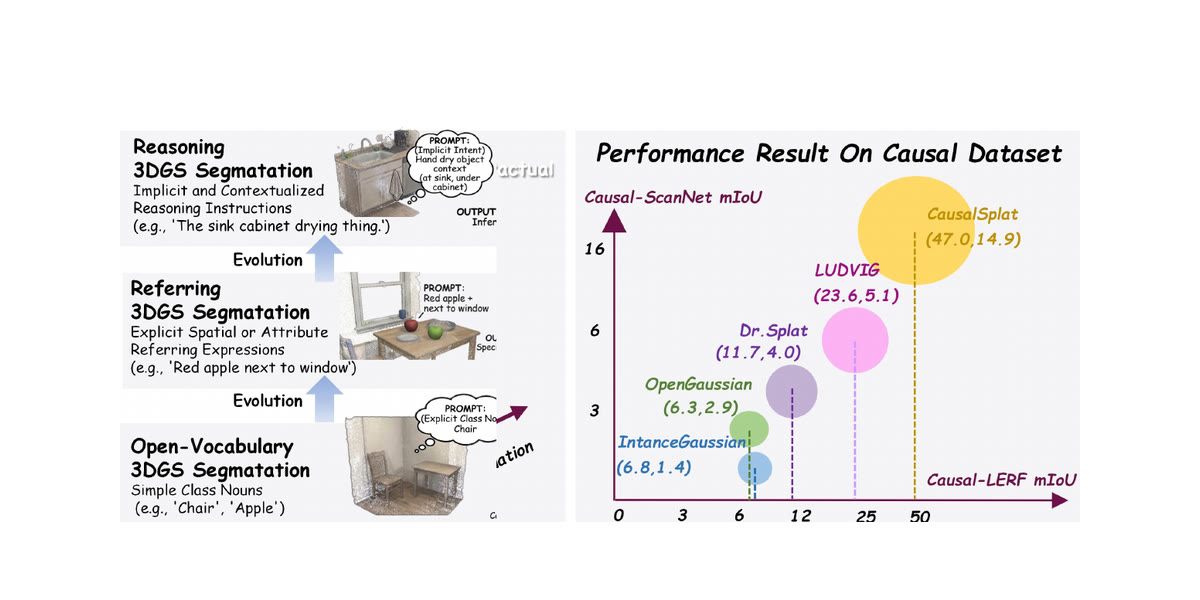
Left: three tiers of splat scene queries, from plain class nouns up to implicit prompts like 'the sink cabinet drying thing'. Right: a bubble chart placing CausalSplat well above LUDVIG, Dr.Splat and OpenGaussian on both benchmarks

Figure: Ding et al., Peking University Shenzhen Graduate School · Research

Priya Raghunathan

Priya Raghunathan

Aug 13, 2026, 7:05 AM ET-Research

CausalSplat, a framework from Jiayu Ding and colleagues accepted to ECCV 2026, integrates vision-language models with 3D scene graphs so gaussian splatting scenes can handle implicit intents, spatial constraints and commonsense reasoning instead of only explicit queries.

Why it matters: Open-vocabulary scene understanding on splats has gotten good at explicit lookups — "find the red chair" — but embodied agents need answers to questions the scene never labels: where something would go, what an object affords, what changes if it moves.

That gap is exactly what stands between photorealistic splat reconstructions and robots that can actually act inside them.

Zoom in: The framework's core move is disentangling explicit structural perception from implicit logical inference: a 3D scene graph carries the scene's structure, while a vision-language model handles the reasoning on top of it.

By the numbers:

  • Two new evaluation datasets — Causal-LERF and Causal-ScanNet — systematically test commonsense, spatial, affordance and counterfactual reasoning.
  • Current state-of-the-art methods perform poorly across those reasoning challenges, the authors report.
  • CausalSplat sets a new state of the art on the reasoning benchmarks while staying competitive on standard referring and open-vocabulary 3D segmentation.

What's next: The paper, submitted August 11, heads to ECCV 2026 — and the two benchmarks give a subfield that has mostly graded itself on segmentation masks a scoreboard for actual reasoning.

Go deeper:
  • CausalSplat on arXiv
⟵ Back to the brief

More stories

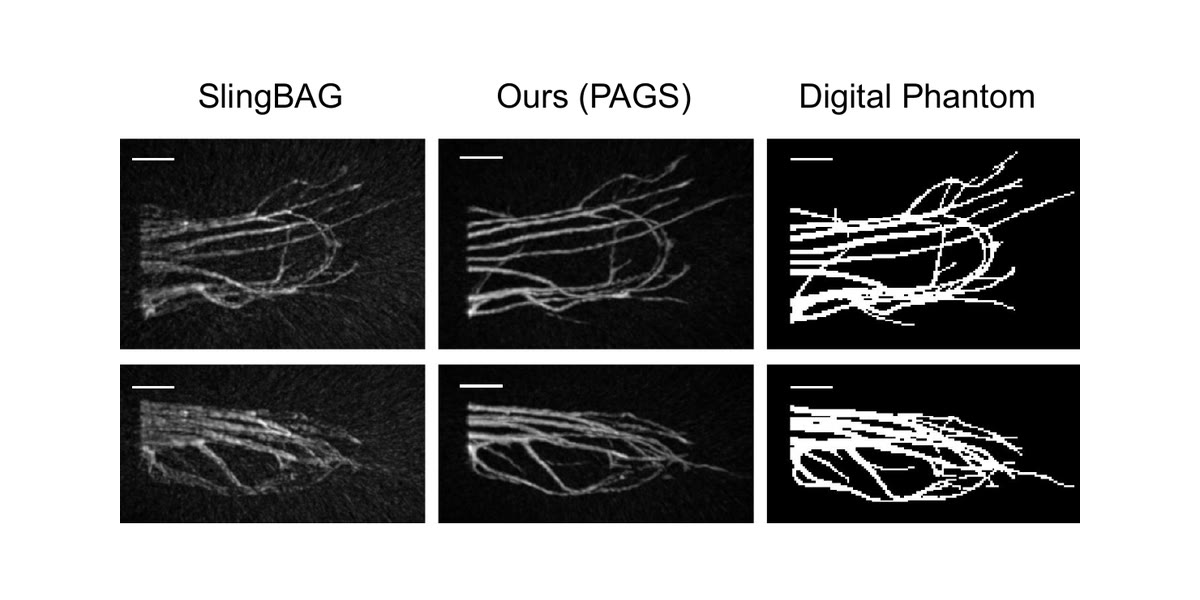
Two rows of photoacoustic reconstructions of a branching vascular phantom, shown for SlingBAG, for PAGS, and as the ground-truth digital phantom. The SlingBAG panels carry a mottled noise floor around the vessels; the PAGS panels are cleaner, with the vessel network closer to the crisp white tracery of the phantom

Splatting, but the light is sound and the camera is a transducer

5 mins ago

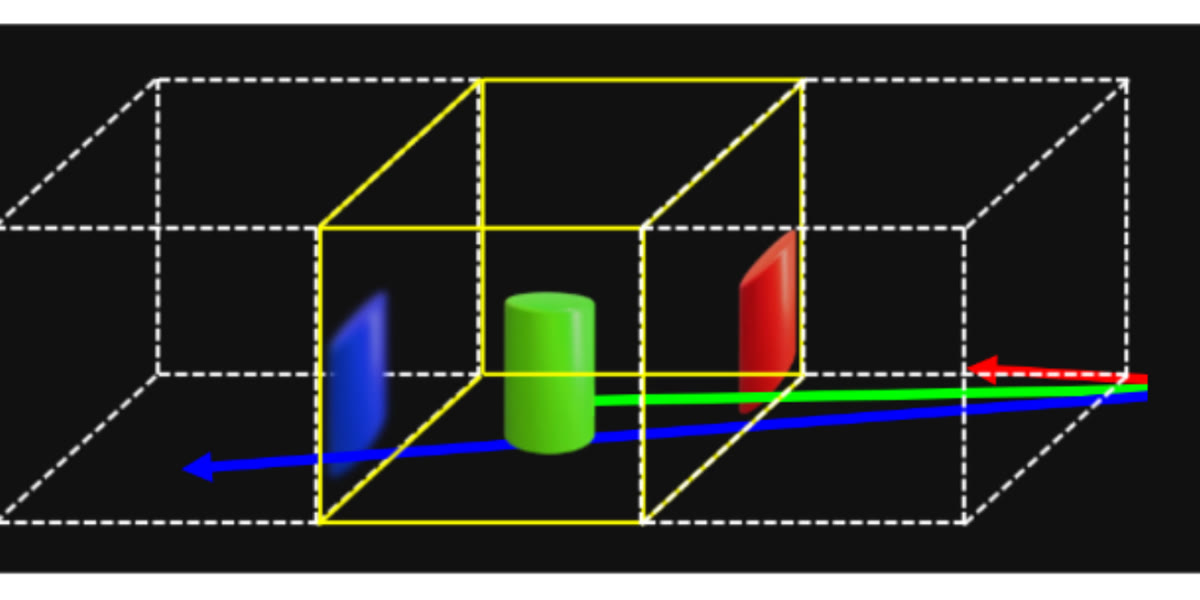
A schematic of a scene divided into a wireframe grid of cells against black. One cell is outlined in yellow and holds a sharp green cylinder; a blurred blue slab sits behind it and a red slab in front, standing in for the frozen regions flattened into single background and foreground images

Their trick makes VRAM independent of scene size. The test scenes were too small to show it.

6 hours ago

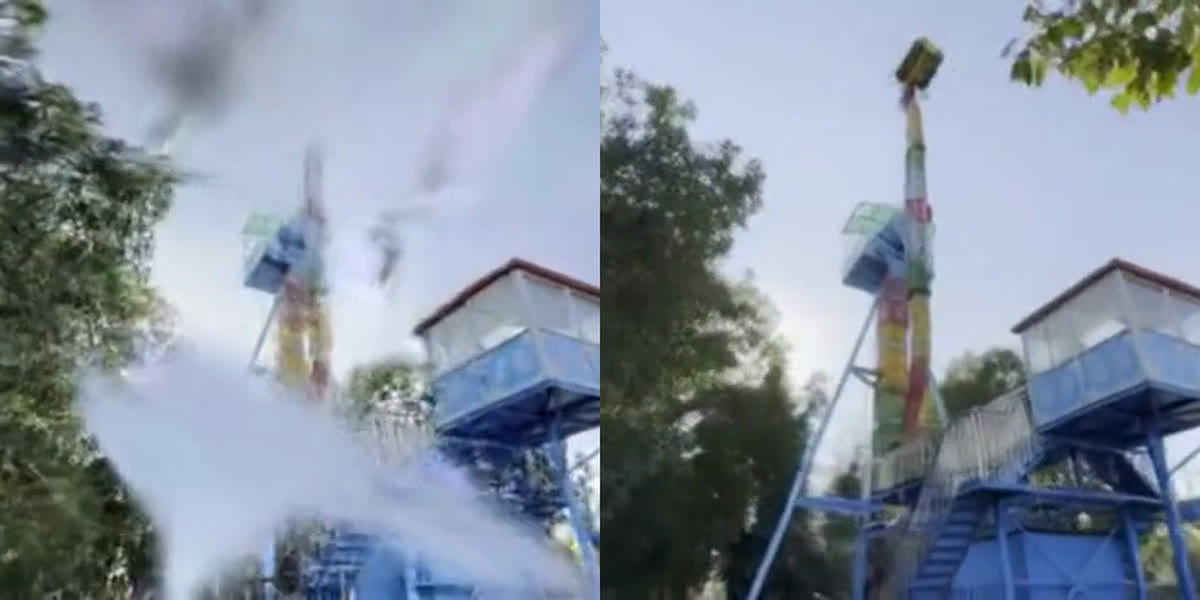
A fairground drop-tower ride rendered twice: on the left from a degraded reconstruction, where the tower and foliage dissolve into white streaks and smears, and on the right after refinement, sharp and photographic against a clear sky

Give it scattered keypoints and it matches a full splat reconstruction

3 days ago

Six holographic reconstructions of laboratory equipment photographed against black through a HoloLens: a Bunsen burner and a rack of capped test tubes above, and below them a shredded, torn reconstruction of a mortar and pestle beside two further mortar-and-pestle models whose pestles are visibly deformed

PSNR said Gaussian splatting won. Seventeen people said it didn't.

3 days ago

splats

Short daily briefs on the evolution of media — gaussian splats, volumetric video, dome theaters, headsets, and the research underneath.

Newsroom

  • Latest
  • All stories
  • RSS feed
© 2026 Splats · Terms · Privacy