Two blurry photos are now enough for a 3D scene
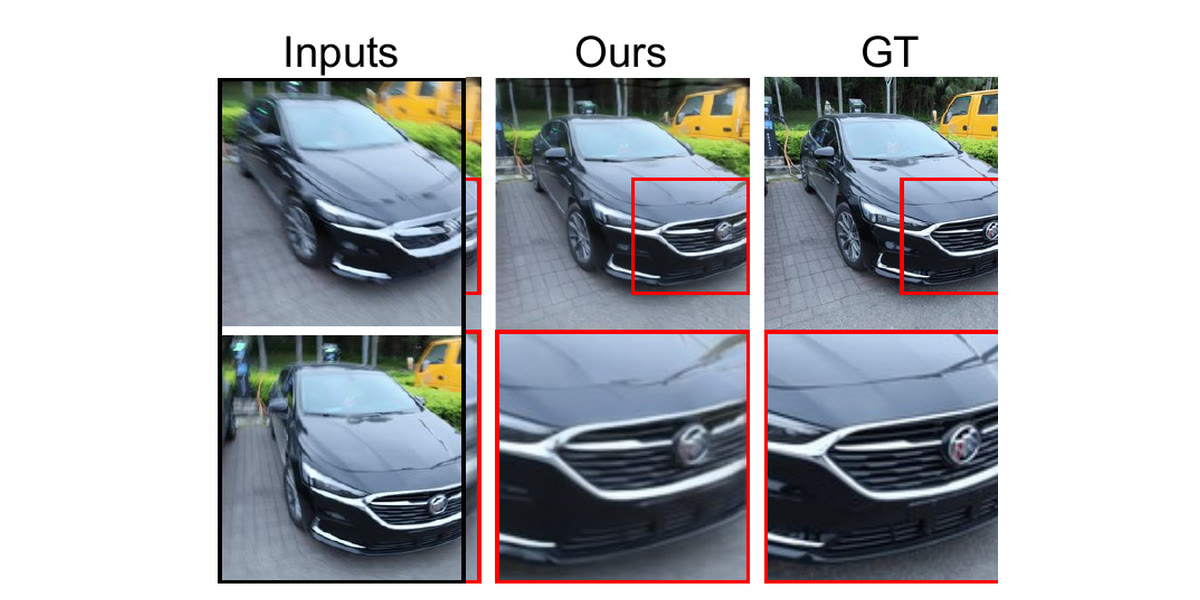
Figure: Choi et al., University of Virginia / KT R&D Center · Research

Haeyun Choi, Minhyuk Jang and I-Gil Kim, at the University of Virginia and KT's R&D Center in Seoul, set themselves a deliberately punishing capture setting — two blurred frames, known intrinsics, nothing else — and get usable novel-view synthesis out of it.
Why it matters: Every splat pipeline is a negotiation with how carefully someone filmed. The published results assume a steady orbit and enough overlap; real capture is two frames grabbed while walking past.
Existing blur-aware methods lean on redundancy to escape the problem — plenty of views, accurate poses, or a slow per-scene optimisation. Remove all three and the field has had little to offer.
How it works: The framework is cascaded, working from local evidence outward to global. Stage one builds locally reliable guidance by filtering cross-view correspondences for occlusion and forward-backward consistency, so only trustworthy matches survive.
Stage two takes those intermediate restorations and fuses them into a provisional pose-free 3D gaussian representation. Re-rendering that provisional scene back onto the input views supplies dense global guidance for a final restoration pass — the 3D scene becomes the thing that cleans up the 2D images that built it.
By the numbers:
- PSNR gains of 1.19 dB on real-world Deblur-NeRF scenes and 2.11 dB on synthetic ones over the strongest baselines.
- 21.13 dB PSNR, 0.700 SSIM and 0.228 LPIPS on the real-world subset.
- No input-view poses, no auxiliary sharp images, no test-time optimisation per scene.
- The method stays pose-free and generalisable rather than fitting each capture from scratch.
Yes, but: The authors are straight about why the gaps are large: the baselines are being run outside their native settings. GAURA normally trains on eight to twelve source views and infers from ten; CoherentGS expects three, six or nine. Restricted to two inputs they are working well below the redundancy they were designed around.
21 dB is a modest absolute number. This is a result about recovering something coherent from a hopeless capture, not about matching a careful one.
What's next: The useful finding is buried in the comparison with DAVANet and Difix3D+, which share the same frozen backbone: simply applying a strong 2D restoration model before reconstruction is not enough. The gain comes from letting the emerging 3D representation feed back into the deblurring.
That is a pattern worth watching beyond blur — 3D structure as a prior for fixing the images it was built from.