A free-flyer rebuilt the ISS interior from photos it took five years ago
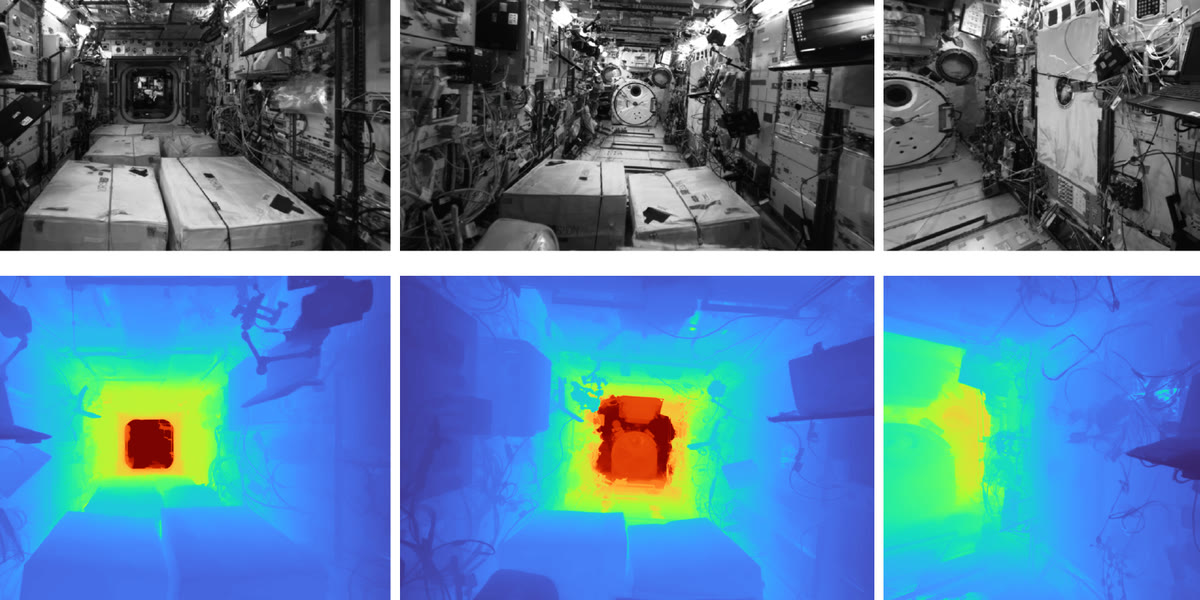
Figure: Kim et al., UC Berkeley / NASA Ames / Caltech · Research

Aug 25, 2026, 12:20 PM ETResearch
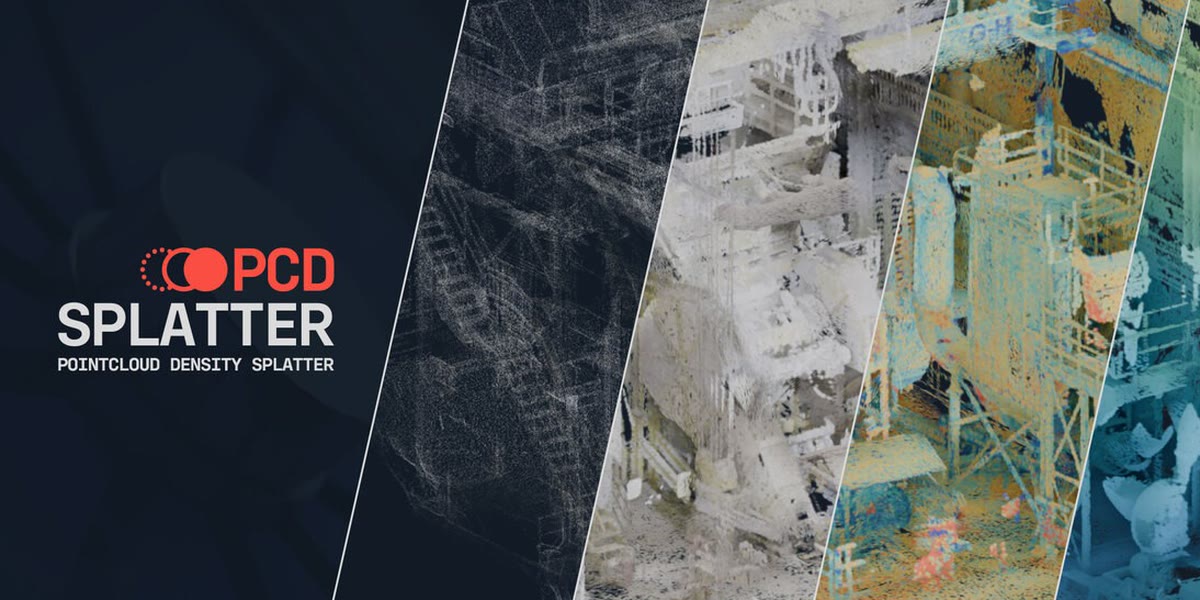
Hudson Kim of UC Berkeley, Ryan Soussan and Brian Coltin of the Intelligent Robotics Group at NASA Ames, and Jordan Kam of Caltech have published what they believe is the first 3D Gaussian splatting reconstruction of the International Space Station — built entirely from grayscale navigation images an Astrobee free-flying robot already collected in April 2021.
Why it matters: The inside of the ISS changes constantly. Cargo arrives and is stowed, payloads are swapped, cables get rerouted, equipment migrates. The reference model ground controllers work from is a static CAD file, which is accurate about what the station was designed to be and silent about where anything currently is.
That gap is the whole argument for this paper. Astrobee has been flying inside the station since 2019 doing inspection and research tasks, and its front-facing navigation camera has already produced a large open dataset. If that existing imagery is enough to build a photorealistic, freely explorable model, then updating the map becomes a thing the station can do to itself during downtime rather than a project.
How they did it: Five Astrobee survey flights through the Japanese Experiment Module — pointing the NavCam forward, up, down, left and right — gave 8,184 raw frames, subsampled to 5,000 by discarding any frame where the robot had moved less than 1.5 cm and rotated less than 0.75°.
The interesting problem is that those five flights happened at different times under different lighting, so the same handrail photographed on two runs may not match as the same feature. Rather than trusting appearance, the team proposed matching candidate image pairs using Astrobee's own onboard localisation poses: if the robot's navigation system says two frames overlap in space, they are offered to the matcher regardless of how different they look. Global structure-from-motion via GLOMAP then solves all rotations, positions and points at once instead of growing the reconstruction one image at a time.
That single change — pose-proposed matching instead of appearance-only matching — is worth 10.25 dB of PSNR and cuts nine and a half minutes off the solve on a 549-image subset. The resulting 1.5 million SfM points initialise the splat optimisation, and each flight carries a small learned appearance embedding, a global gain and bias, so differences in cabin lighting between sessions do not have to be explained by the geometry.
By the numbers:
- 31.19 dB PSNR, 0.918 SSIM and 0.208 LPIPS across 625 held-out views, from 1.21 million Gaussians rendering at 75.2 fps on an RTX 3090 Ti.
- Roughly 500 images is the knee of the curve: 549 frames reach 30.04 dB in 1.3 hours end to end, against 31.19 dB in 5.8 hours for the full 4,375. Ten times the data buys just over a decibel.
- Drop to 140 images and it falls apart properly — 25.25 dB, with LPIPS finally moving off 0.208 for the first time in the table.
- SfM is the expensive stage, not training. Training holds at about 45 minutes regardless of image count; the solve swings from 18 minutes to 5 hours.
- Median disagreement between the recomputed SfM poses and Astrobee's own visual localiser: 6.7 cm.
Yes, but: The baselines are generous. Beating Nerfacto, Instant-NGP and TensoRF in 2026 establishes that explicit Gaussians beat neural fields, which was settled some time ago. The comparison that carries weight is against Splatfacto — ordinary 3DGS on the same data — and the paper attributes that margin to its pose pipeline and appearance embeddings rather than to anything about the representation.
The iteration table has a hole in it. Quality climbs from 25.29 dB at 15,000 steps to 31.19 dB at 90,000, except at 30,000 steps, where it reads 20.61 dB — worse than half the training. Nothing in the text accounts for a five-decibel trough in the middle of an otherwise monotone curve, and a reader has to decide whether it is a densification instability or a transcription error.
The most awkward limitation is the one closest to the motivation. 3DGS assumes a static scene, and these five flights span multiple sessions during which the station genuinely changed — so the things that moved show up as blur. The pitch is a map that keeps up with change; the method currently smears the change it catches in the act.
And the imagery is grayscale and low-resolution, because that is what a navigation camera is for. There is no colour and no fine texture in the model. The authors point at Astrobee's science camera as future work.
The big picture: Nothing here required new hardware, a new flight, or crew time. The robot, the camera, the flights and the dataset all already existed; what changed is that somebody ran a different solver over five-year-old grayscale footage and got a model you can fly through at 75 fps.
That is the useful shape of the result for anywhere hard to reach — a habitat, a reactor hall, a mine. The instrument that was installed for navigation turns out to have been collecting reconstruction data the whole time, and the constraint was never the sensor.