The water got murkier and the scores went up
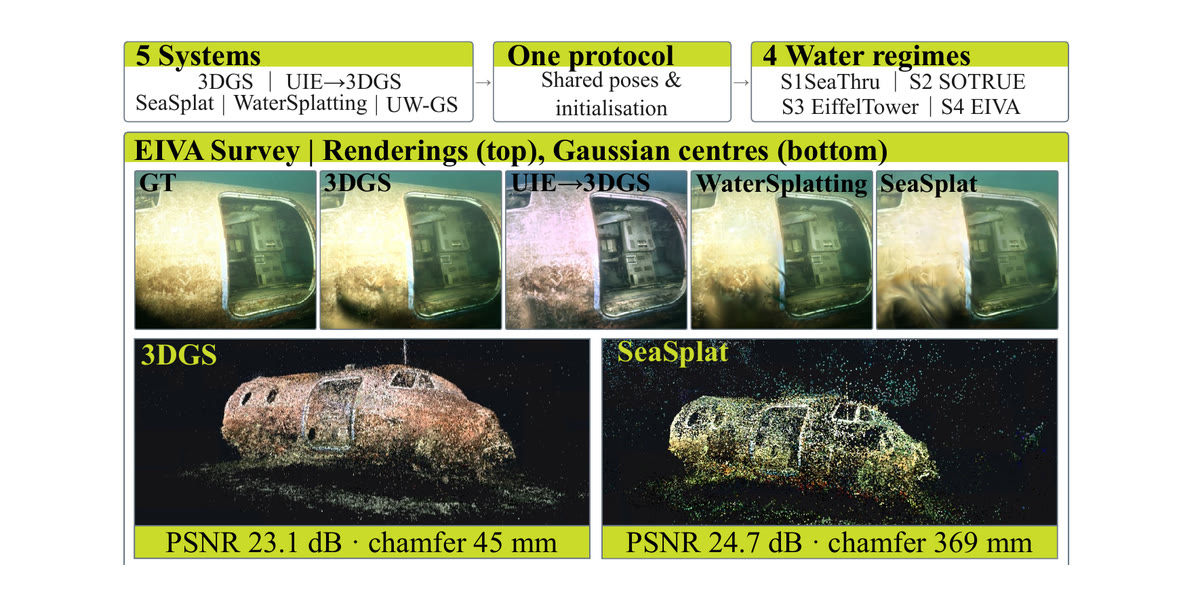
Figure: Álvarez-Tuñón and Graßhof · Research

Two underwater Gaussian splatting papers appeared on Monday, each declaring state of the art on an evaluation set it had assembled itself, neither citing the other. Olaya Álvarez-Tuñón and Stella Graßhof have now done the thing that was missing: taken five underwater splatting systems with public code, run them under a single protocol with shared poses, initialisation, compute budget and evaluator, and pushed them across four water regimes. The conclusion is that the architecture matters less than the setup, and that the numbers the field reports do not show it.
Why it matters: Underwater splatting has a benchmark culture problem that is easy to state and hard to see: the standard photometric metrics reward a model for fitting the water rather than the scene behind it. Haze is smooth, low-frequency and highly predictable, so a system that commits opacity to the veil scores well on held-out views while placing its geometry in the wrong place.
Because most published comparisons vary the architecture and the dataset together, that failure never surfaces. Running everything under one protocol separates them, and what falls out is that several confident published rankings invert depending on which water you are in and where the light is.
By the numbers:
- The dose-response is the headline. In a tank with measured turbidity, plain medium-blind 3DGS improves from 32.0 dB in clear water to 35.9 dB at 7 NTU, while its surface error against a stereo reference degrades from 99 mm to 848 mm. Murkier water, better score, geometry eight and a half times worse.
- Structure-from-motion fails before rendering gets a chance. On identical trajectories, COLMAP registers 99.5% of frames in clear water, 1.0% at 7 NTU — a single two-view pair — and 0.0% at 12 NTU, where not one match survives.
- On the industrial survey, the medium-aware SeaSplat posts 24.7 dB with 369 mm of chamfer error and 353 minutes of training. Plain 3DGS posts 25.9 dB, 58 mm and 28 minutes. WaterSplatting posts 25.7 dB, 46 mm and 34 minutes.
- Its stray mass is not haze. SeaSplat's floater mass on that scene is a low 0.003, but its ICP fitness of 0.71 means 29% of the opacity it committed has no counterpart on the reference surface — solid geometry, confidently placed, in the wrong location.
- The fifth system did not finish. UW-GS was terminated at 19,000 of 30,000 iterations after 13.5 hours, roughly 30× slower than its peers.
- In deep water lit by a lamp mounted on the camera, vanilla 3DGS beats SeaSplat by 1.1 dB and WaterSplatting by 3.8 dB. WaterSplatting's medium field is conditioned on view direction, so a light that moves with the camera reads as directional; the field absorbs the illumination and most of the scene with it, leaving 27,000 Gaussians where the others build 1.9 million.
What the ablation found: Taking SeaSplat apart produces the study's most quietly damning result. Switching off its depth supervision costs 2.8 dB — and improves the geometry, cutting floater mass by 31% while using 0.62 million Gaussians instead of 3.35 million.
The authors explain why, and the explanation generalises well beyond this paper. Depth losses are supposed to pull mass onto surfaces. But the cheapest way for an optimiser to satisfy them is to hang thin semi-transparent sheets in front of the surface, so that is what it builds. The prior does the opposite of what it was added to do, and photometric scores applaud.
The appearance terms do not decompose cleanly either. Removing the backscatter term alone costs 10.4 dB, while removing the entire medium model costs only 6.2 dB — attenuation without its veil term darkens the render further than having no medium model at all.
Yes, but: The single most consequential number in the study is not about any of the systems. Rerunning plain 3DGS on a sparser version of the same dive, every sixteenth frame, drops it from 27.0 dB to 16.5. View overlap is worth 10.5 dB — more than every difference between methods anywhere in the paper. Read strictly, that says most of this literature is arguing over a margin smaller than the one controlled by how carefully somebody swam.
The comparison also has honest limits the authors flag. Three of the survey chamfer figures — 45, 46 and 58 mm — differ by less than the 12 mm alignment residual they are measured through, so those three systems are tied rather than ranked. One scene carries no metric geometry reference at all, so geometry there is floater mass alone. And repeat runs of the same configuration spread by 82 mm, which is the noise floor for the depth column.
One practical caveat for anyone hoping to build on it: the paper says scene builds, per-run configurations and evaluation code are released on GitHub, and as of publication that repository returns a 404. For a contribution whose entire value is a reproducible shared protocol, that is the part that needs to land.
The big picture: The useful finding for anyone actually surveying something underwater is that a classic image-enhancement pre-pass in front of vanilla 3DGS matches the purpose-built medium-aware architectures on geometry, at a fraction of the training cost. The specialised machinery is earning its keep in shallow, evenly-lit, clear water, which is the regime it was developed and tested in.
The broader lesson is about metric choice rather than water. A field that reports PSNR on held-out views, and nothing about where the mass went, has built an instrument that cannot see its own dominant failure mode. This paper reports both axes for every run, and the two disagree almost everywhere.