PSNR said Gaussian splatting won. Seventeen people said it didn't.
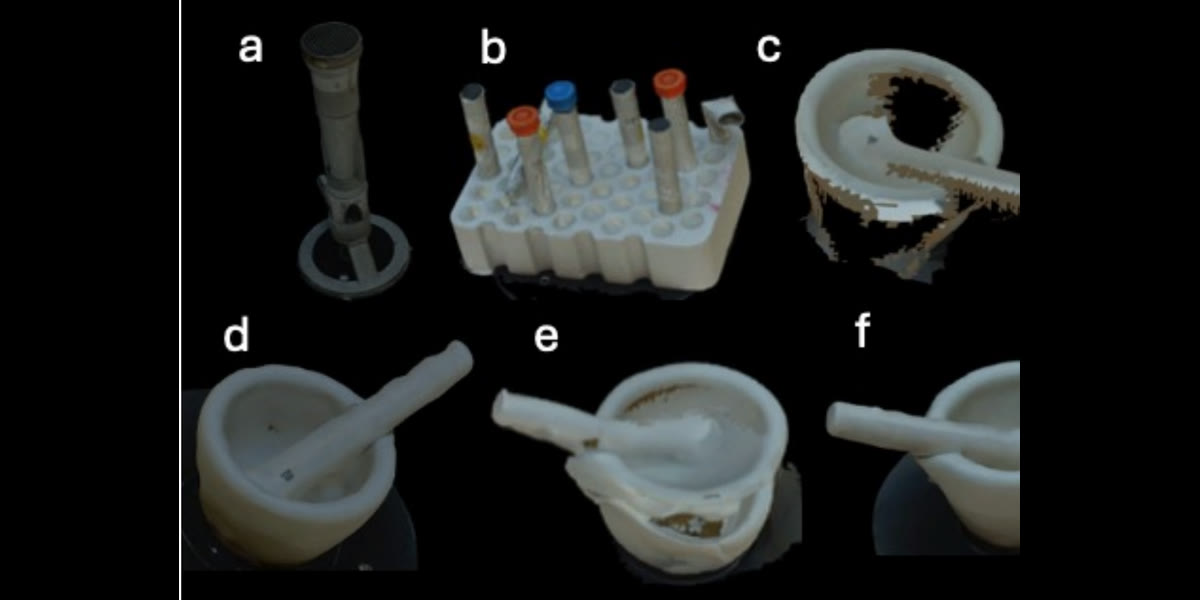
Figure: De La Cruz et al., UNC / University of Colorado (CC BY 4.0) · Research

Aug 28, 2026, 8:10 PM ETResearch
Laboratories are an awkward place to point a camera. They are full of the things reconstruction is worst at — glass, chrome, amber bottles, smooth white porcelain with no texture to match against — and the reason anyone bothers is that a robot has to pick those objects up, or a student has to inspect them before touching the real thing. Two groups published lab reconstruction studies within a day of each other this week, and they disagree about whether Gaussian splatting is the right tool.
Why it matters: Both studies are asking a question the benchmark literature mostly skips: not which method scores highest on held-out views of a garden, but which one produces something a person or a robot can act on.
A group at Argonne National Laboratory benchmarked NeRF and 3D Gaussian splatting across the compute a laboratory robot might actually carry — an NVIDIA Jetson AGX Orin, an RTX-class desktop, and an A100 node in the Leadership Computing Facility — and measured what it costs to keep a reconstruction inside a control loop.
A group at North Carolina and Colorado did something different: they built holograms of twelve common laboratory objects with four methods and had seventeen expert raters inspect them through a HoloLens, scoring shape, colour, texture and freedom from defects.
Where they disagree:
- Argonne's numbers favour splatting unambiguously. On every platform, 3DGS beat NeRF on image quality: 24.32 dB against 18.96 on the A100 node, 23.21 against 20.37 on the desktop, 24.06 against 19.14 on the Jetson.
- The rating study points the other way. Across twelve objects scored one to five, Gaussian splatting was the top method on none of them, and last or joint-last on eight.
- NeRF produced the most models above the study's high-fidelity threshold and the fewest in the fair-to-poor range. LiDAR won several objects outright. Photogrammetry and Gaussian splatting were the two that most often produced low-rated models.
- The gap is widest exactly where a laboratory lives. On the squirt bottle, splatting scored 4.2 against NeRF's 4.6; on the amber bottle, 1.8 against 3.7; on the mortar and pestle, 2.1 against LiDAR's 3.8.
- Two objects were sprayed with cyclododecane — a coating that sublimes away — purely to dull their reflectivity for the scan. That is the workaround the field currently has for glass.
Why both can be right: The two studies measured different things and got answers appropriate to each. PSNR compares a rendered pixel to a photographed pixel from a held-out camera. It rewards a method that reproduces the image, including the specular highlight that a splat can bake in as an opaque blob because it happened to be there in training.
A rater inspecting a hologram from an arbitrary angle in AR is doing something the metric cannot: walking around it. A baked highlight that matches one photograph is a defect from every other viewpoint, and that is precisely the category the study found splatting losing on — transparent, reflective and low-texture objects, where defects were most common.
This is the third time in a fortnight that a study has found photometric scores and human or geometric assessment pulling in opposite directions on splats. The underwater cross-regime work found PSNR improving as the water got murkier, while surface error grew eightfold. A motion-aware filtering paper found a twelve-decibel gain that its own authors could barely see.
Yes, but: Neither study is large. The rating work used seventeen assessors on twelve objects, and its own statistics note that for the simpler objects all four methods scored comparably — the separation appears only on the hard ones. The Argonne benchmark is a workshop paper and describes its SAM3D comparison as preliminary.
They also used different pipelines, and no one has shown that the splatting implementation in the rating study is the one Argonne measured. A tuned splat reconstruction of a glass flask might do better than the one seventeen people looked at. Neither paper claims otherwise.
The Argonne results carry a separate oddity worth flagging on its own: the A100 node rendered splats at 0.78 frames per second while the RTX 2080 desktop managed 24.16. Datacentre accelerators are not built to rasterise, and anyone planning to serve splat rendering from HPC hardware should measure before assuming.
The big picture: The practical finding from Argonne is that per-scene optimisation does not fit inside a robot's control loop on the robot's own computer: 90 minutes of training on the Jetson to reach 4.87 frames per second. Their recommendation is a tiered pipeline — something feed-forward and fast holding the real-time perception loop, with the expensive reconstruction scheduled deliberately, elsewhere.
The finding from the rating study is narrower and more uncomfortable. For the specific job of making a laboratory object that a person will inspect from every angle, the older method won. Not because splatting renders worse, but because it renders a photograph well and an object less well, and the difference only shows up when someone walks around it.